
#195: How to Create A Coaching Business with Creativity & Intuition with Jill Badonsky
Are you starting a coaching business and wanting to navigate from your intuition and creativity?
Today, our host, Christina Barsi sits down with returning guest Jill Badonsky, founder of Kaizen Muse Creativity Coaching, for a deep dive into the journey of building a coaching business rooted in creativity and intuition.
Drawing from her rich background in psychiatry and art therapy, Jill Badonsky shares how her passion for creativity inspired her to break away from traditional workplaces and forge her own path. She reveals the challenges she faced—like overcoming burnout, resisting linear life coaching methods, and navigating the overwhelm that often comes with starting a business. Jill explains why she ditched the “one-size-fits-all” business plans in favor of intuitive, energized steps that felt aligned with her values and personality.
This conversation is packed with actionable insights, from reframing the way you approach business tasks (turning “I have to” into “I get to”), to trusting the process, leveraging the power of fun, and crafting unique offerings that resonate with clients.
Christina Barsi is also certified in Kaizen Muse Creativity Coaching, and together, they discuss how to stand out in a crowded coaching market, avoid the pitfalls of comparison, and focus on service and self-kindness to create an authentic, rewarding coaching business.
If you’re dreaming of launching your own coaching practice—or looking to infuse more joy and intuition into your business—this episode is your nurturing guide for turning creative passion into a sustainable enterprise.
In this episode, you’ll learn:
Ways to navigate comparison, perfectionism, and overwhelm as a creative or business owner
The importance of small, imperfect steps as a gateway to momentum and flow
How presence, mindfulness, and gratitude support sustainable creative lives and businesses
How storytelling and mediums like podcasting can build your business
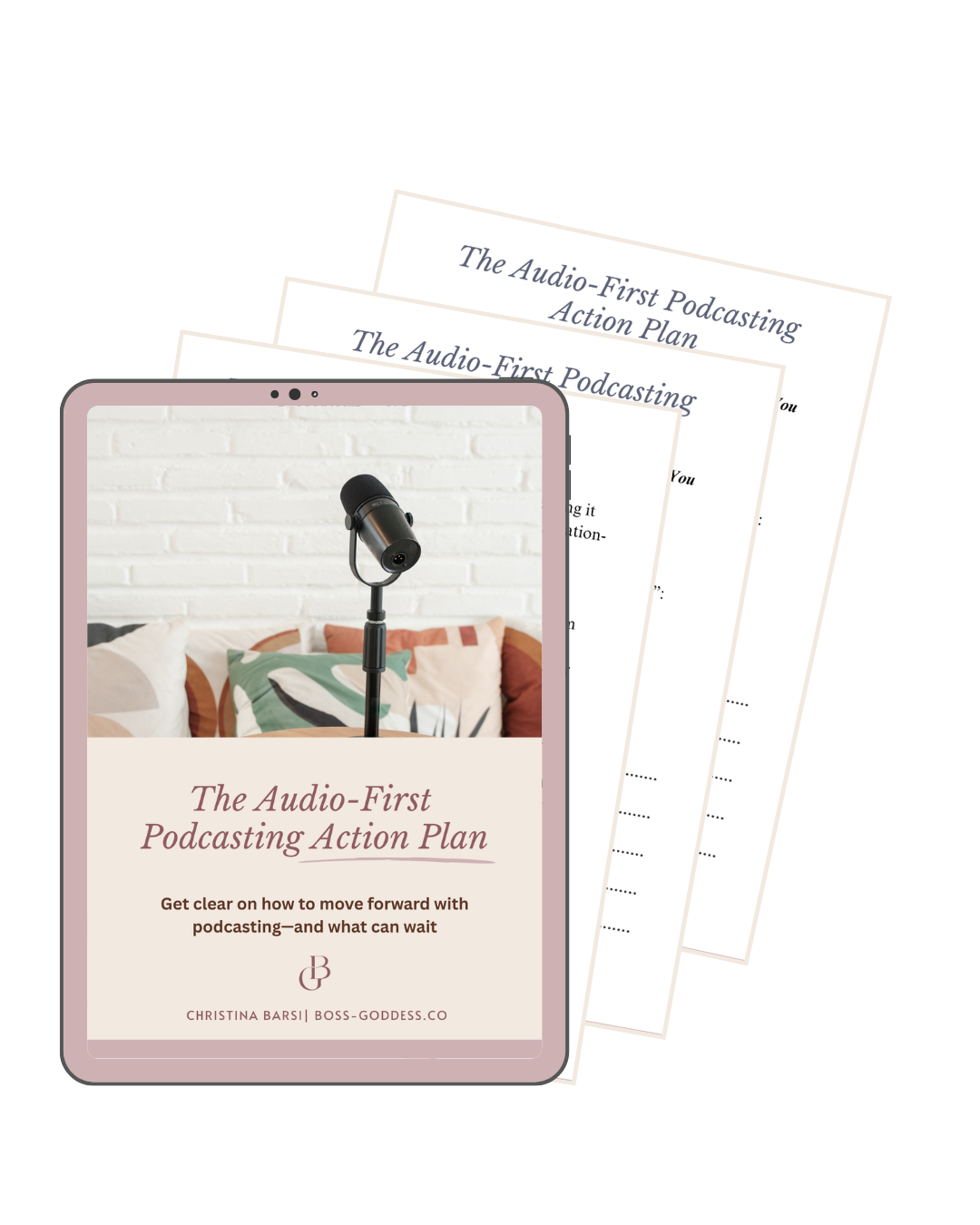
The FREE Audio-First Podcasting Action Plan
Get clear on what you actually need to start your podcast (and what you don’t)
00:00 Journey from Psychiatry to Creativity Coaching
11:05 Overcoming Fear to Embrace Trust
14:36 Creativity, Independence, and Burnout
16:27 Creating a Business On Your Terms
23:53 Ripple Effects of Gratitude
31:59 The Power of Creative Questions
36:12 How Storytelling and Podcasting Work for Coaching Businesses
42:38 Start Small, Trust Yourself
Launch Your Passion with Podcasting Toolkit - $37
Learn how to create & launch your podcast with a zero-dollar budget.
Stop waiting to share your magic and start supporting and expanding your brand and business in the most authentic, aligned and engaging way possible.
Read the Full Transcript
Christina Barsi [00:00:32]:
I'm here today with a return guest, the amazing Jill Badonsky. Welcome back, Jill.
Jill Badonsky [00:01:17]:
Thanks for having me again.
Christina Barsi [00:01:19]:
Absolutely. One of my favorite people to talk to and be in your energy with.
Jill Badonsky [00:01:24]:
Aww, ditto.
Christina Barsi [00:01:28]:
You can't see this if you're listening, but I have your books right behind me on the bookshelves back there, and I, I love to just creatively touch them and look at them. They're so fun. They're just really fun books.
Jill Badonsky [00:01:40]:
I needed to make them fun in order to get them written. It had to be a fun process. Yeah.
Christina Barsi [00:01:47]:
That makes so much sense. Yeah.
Jill Badonsky [00:01:49]:
Yes.
Christina Barsi [00:01:49]:
So I realized that I don't know a whole lot about how you got started in this journey that I know you from, which is Kaizen Muse Creativity Coaching. I'll give a formal intro in just a moment, or a more formal one than this, but I would love to talk about how all of that began for you. A little bit about what you did before and how you ended up on this path. Is that okay with you?
Jill Badonsky [00:02:11]:
That is fine. Yeah, it's a long story, so I don't want to bore your listeners. I'll do the Reader's Digest version, but I started out in psychiatry working with adolescents with creativity and saw the power of creativity to help people through depression and attention deficit disorder and all sorts of behavior problems. I just fell in love with creativity, got my master's degree in education, and then I got lost. I started getting promotions and became a program director of child and adolescent units in private psychiatric hospitals. And so my creativity was going to a place that in one sense it was helping children and adolescents, but it was really helping these hospital systems which were for-profit. And after a while, just burnout on that, went back to being an occupational therapist, but then I started to conspire my escape from working for anybody else and started teaching The Artist's Way and writing articles for women's newspapers on creativity. Everything was on creativity.
Jill Badonsky [00:03:22]:
And wanted to write a book, wanted to write my first book on creativity, and was procrastinating and overwhelmed and not thinking it was something I could do. So I got a life coach and she blocked me. She blocked me, and I started telling her what she needed to tell me in order to get through my block. And I thought, how many people are getting blocked by life coaching? Because this particular life coaching— and there's all sorts of exceptions— was very linear, and I was being told what to do. And as you know, creative people do not like to be told what to do. And it was overwhelming. The first 15 minutes, I was like, okay, I'm done. And I didn't do things in between our sessions because I'm a perfectionist.
Jill Badonsky [00:04:06]:
I was like, oh, this This is all wrong. I don't want to even show up. So I took all of that information and I thought, how many people need a creativity coach rather than a life coach? And all of this stuff I was discovering for how to get my own book written, I was writing about. And that became the book, and then the book became workshops, and the workshops turned into this coaching training. And just— it's been going on for 18 years now, and taken on a life of its own, and hundreds of creativity coaches out there, which we really need. We need more of them too, because they're not just working with people who want to be creative, they're working with people who want to create something in their life differently. And the tools themselves are creative, so it might work for writers and artists, but it also works for anybody on any kind of life path.
Christina Barsi [00:04:58]:
Yes. Okay, so many things you said in there a nice tight compact package. I'm sure you've told your story many times and you tell it well. But I'm remembering, as you're telling your story, I'm remembering what got me interested, why I gravitated to your program in the first place. And it was because you taught The Artist's Way as well. And I could see that, that energy in what you were presenting just online. I just came across you, just your website. I was searching for the next thing or some answers or some guidance in my life at the time.
Christina Barsi [00:05:32]:
And I saw you and I saw The Artist's Way. I'd done The Artist's Way. For like a year. It took me so long to do it.
Jill Badonsky [00:05:39]:
It takes a lot of people a long time, even longer than that. Yeah.
Christina Barsi [00:05:43]:
And I felt like nothing worked, but it took probably another year for me to see how it impacted my life. And this was about at that time when I was really seeing the impact of it when I found you. And I was like, oh my goodness, this person speaks my language. And I had no idea I even needed this in my life, but I think this is what I'm supposed to do next. So I relate to your story about, well, I just followed the next thing and the next thing, and it just got me to what I like to say, like, a very aligned path, your intuitive path in some ways, which I learned from you. Honestly, I'd never heard anyone talk about intuition before in the way that we do in the program. So for those of you who don't know, I'm a certified Kaizen Muse Creativity Coach. Jill is the creator of that training.
Christina Barsi [00:06:28]:
So this is like the yummy conversation for me because it's everything I love and it's everything I talk about all day long anyway. She's the goddess of just everything that grew me to become what I am now. And then the influences along the way. Of course, there's other things, but I learned these foundational things from you, Jill, and it changed my life completely. So that's my testimonial. But all that said, I do want to ask you, you started working with children first. What called you to that as your first step out into working creatively in the workforce?
Jill Badonsky [00:07:00]:
I just could identify with these adolescents who were lost. I wasn't that much older than them when I started working with them, but I had a pretty checkered childhood and adolescence. So, you know, when we talk about intuition, it's hard to explain why I did things. It was just these gut feelings, and then it was the passion that kept me there. But the children and adolescents, the art and the art therapy was healing to them, and I felt like it was healing to me too. So I was really passionate about that, and I, I didn't analyze it, you know, consciously in terms of, oh, I had a really hard time as an adolescent, so I'm going to help these adolescents. It was just— I was just drawn to helping them. And plus, I found it a real challenge because adolescents are not easy to work with.
Jill Badonsky [00:07:51]:
And I found this whole thing that I now teach other people in terms of allowing, allowing people to be who they are. You know, when we're creative, we're sort of adolescents because we're very oppositional. We don't want to be told what to do. Adolescents don't want to be told what to do. So it was really a challenge to lure them into these things, just as it is to lure ourselves into what we want to do. So, and just being able to see the results when, you know, these were inpatient units, so when the nurses came to see them in these creativity clinics, they didn't recognize them. They were like different people when they were engaged in creativity. Their self-esteem self-esteem was there.
Jill Badonsky [00:08:33]:
They were in control at a time when they weren't in control of their body. They weren't in control of their life. They were in a hospital, so they felt out of control. But given some sort of creative task to do gave them that control again. And again, I think that's why it's so appealing right now. We're feeling out of control in so many ways that writing and art and anything creative gives us sort of the power to create our own world. In a way that develops it and we're able to relax a little bit in it. So that was part of it.
Christina Barsi [00:09:06]:
Wow. It's so interesting how just sharing that little part of the story really shows us the power of creativity and engagement and how, you know, I feel like sometimes there's this misnomer that artists are so free-spirited that they have no focus and they're all over the place and all of these things. But really creativity brings you to a moment of presence and focus in a way that some other things might not be able to do. And I think that in itself is so powerful and useful.
Jill Badonsky [00:09:35]:
There are so many fringe benefits to the creative process. We get so much more than the writing, the art. We get frustration tolerance and perseverance and resilience and resourcefulness and all of those things. Once we stay in the process, we're developing qualities of ourselves that help us live a deeper, higher quality life. So it's all worth it.
Christina Barsi [00:09:57]:
It is. I love watching adults come into their creativity because we forget to do it. Even if we're creative or we identify as creative, it's very easy to forget to do something that might be going trivial, or, you know, I don't have time for that, or I have to get this stuff done, and all of these things that we tell ourselves when in reality, if we allow space for something simple or creative or an exercise like that, it can really help us do the other things we need to do in our lives, right?
Jill Badonsky [00:10:30]:
It's fortifying. I think it's like this little soul vitamin, you know, especially if you have a creative call. If you have a creative call, you really have to answer it because it's more painful not to answer it than it is to answer it and have it go no place or not have it go exactly where you want it to go. It takes us somewhere. It may not take us exactly where we thought it would, but it opens doors if you're paying attention. It's a real spiritual process because you do have to let go. You have to let go and trust yourself. And a lot of what keeps people from doing creativity at all is fear.
Jill Badonsky [00:11:05]:
Yeah, there's so many fears— fears of not doing it right, of wasting your time and having it go nowhere, of judgment, of whatever, and think of the things we could do if we didn't have those fears, you know, which I saw a lot in psychiatry because I worked also with adults who didn't have that fear and they were just free. These were people who were— sanity and creativity, there was a fine line between them, but they didn't have those boundaries and they didn't have the fear. So some of them were incredibly creative because of that. And trust doesn't come immediately, and that's what I teach in the training is we have to develop trust with small steps as well. We have to just ask the question, what would it feel like to trust that even though this doesn't feel like it's going anywhere, you know, it's going to give me something?
Christina Barsi [00:11:57]:
Yeah, the trust I think is at the crux of so much of our growth or our lack of if we're wanting to grow and we get stuck in not getting to our next thing. So much of it has to do with trusting ourselves, developing that relationship with ourselves. And I talk about intuition so often, it's because I think that's where that relationship begins to develop in a deep way.
Jill Badonsky [00:12:20]:
Yeah, trust and intuition really go together, and creativity is one of the most important relationships we can have with ourselves because it's all about what we say to ourselves. We can either say, I'm not good enough, I'm not good enough yet, or who cares whether I think I'm good enough, I'm gonna do this anyway, let's just try this. It's all self-talk, it's all things we're saying to ourselves and being on our own side. And if this doesn't go to where I want it to go, I'm gonna be okay. And again, those kinds of conversations with the self not only serve creativity, they serve us in every single aspect of our life.
Christina Barsi [00:13:01]:
Yeah, it really does. It's hard to separate that, even the feeling, you know, what would it feel like? I love that question, and then fill in the blank. I think that really does connect us spiritually too, because the way we feel is really our experience, how we want to experience life.
Jill Badonsky [00:13:18]:
And it also develops our intuition, right? We don't even need an answer in the moment. Simply asking the question, what would make this easier? What would make this more fun? What's a step I could take with this book? What would this character say? What's something else I could paint? How can I do this differently? Just those questions, because the subconscious loves questions and it can't help but answer them. But when we ask, how come other people are doing things better than me? How come I can never finish a project? The subconscious also works on those and doesn't give us the same benefits as if we create the question in a way that it serves us, the answer serves us.
Christina Barsi [00:13:57]:
Yeah, there's a lot of self-kindness in that practice too.
Jill Badonsky [00:14:01]:
There is, and that is something that is really needed right now, self-kindness.
Christina Barsi [00:14:08]:
Yeah, it's always needed, but it's so needed right now. So going back to your story, you mentioned that there was a moment where you were like, oh, what can I do to stop working for other people and work for myself? What made you decide that that was the stuff for you that you needed to stop working at a quote-unquote job or for someone else?
Jill Badonsky [00:14:28]:
I stopped liking being told what to do.
Christina Barsi [00:14:33]:
I relate. I was just curious what your take was on it.
Jill Badonsky [00:14:36]:
Yeah, I was going to say narcissism, but I think there's a little bit of that in creativity. But I just, you know, I'm sure people can relate to the fact that somebody's telling you what to do and you're thinking you could do it probably better. Than that, or I just can't imagine working with somebody, working for somebody who doesn't have your values or your best interests in mind or common sense. And that happens a lot. And I just have one of those from childhood. I used to just develop programs for my friends and secret clubs and It's in my DNA. So it was really hard to work for other people, which led to promotions to management. But I was working for companies that didn't have real good moral judgment, and that was a big burnout.
Jill Badonsky [00:15:31]:
So being able to put together my own mission statement and develop my own way is just freedom. It's freedom and fun and hard and exciting and just a lot of good stuff.
Christina Barsi [00:15:46]:
Yeah, so starting a business, that's a whole thing, and it's so confusing in the beginning. Did you go through that as well?
Jill Badonsky [00:15:53]:
Thanks for that question. Yeah, I teach business building now because I made so many mistakes, and I think the biggest mistake was thinking it needed to be done a certain way, right? And they tell you it does. They say, okay, put together your business plan. And I put together numerous business plans. In fact, I was the marketing director of a hospital for a while. That's where my promotions brought me. And I would do a quarterly plan and then present it to the whole staff, and then it went into a folder and never used it. It was my intuition and common sense that led me.
Jill Badonsky [00:16:27]:
And then, so at the beginning of building my own business, I was filling in the business plans and going to the networking meetings, none of which was anything related to who I was. And I thought, if I have to do it this way, I'm not going to do it. So I need to invent my own way. And it was again what we teach in Kaizen Muse, and that is just what is the next step that makes sense and feels good and energizes me. And for me, it's fun. What is fun next? And, you know, being a student of psychology, you know, I think that helps a lot is what 'What are people going to think of this? Let me put it out there so I can see.' I just had seen a lot of coaching out there, creativity as well, and just felt so passionate about it was wrong. And that was just my point of view, back to narcissism. But just having the drive to see what is working for people and wanting to get that out there.
Jill Badonsky [00:17:29]:
So it was all intuition-based.
Christina Barsi [00:17:32]:
I relate to that. I didn't have a business plan. I never made one. And it's still one of those things where you see another entrepreneur and you're like, what are you doing? Are you doing what I'm doing? Is it the same? Are we doing different things? Is it working for you? It's kind of working for me. Like, it's like this funny inside club, but club of one most of the time.
Jill Badonsky [00:17:51]:
Yeah, and I don't see anything wrong with that. You know, I am kind of the poster child for overwhelm. So when I look at what's out there. I'm like, oh my gosh, look what they're doing. I'm overwhelmed. I might as well quit. And just noticing that mindfully, because mindfulness is a big part of that, and going, okay, how can I deal with that discomfort with comparison? And that is, is just to limit my exposure, but to ask the question, what is one little tiny thing they're doing that I could also be doing but in my own way? And then just let go of the rest. And to see what's out there and limit my exposure to it.
Jill Badonsky [00:18:28]:
Because as you know, comparison derails so many people, they don't even begin.
Christina Barsi [00:18:33]:
Yeah, yeah, yes, yes, that's so common and normal, I should say, because we'd like to normalize. But it is, it's so normal. And I forget sometimes that I have those tools now, just like deep inside me. I don't even know how to identify them sometimes because they're just in action so much. I have the same experience where I get overwhelmed and I can compare myself very easily. So I also limit my exposure and keep my circle kind of tight. But then when I talk to others, they're like, there's already so many people already doing what I do. And it's like, no, because they're not you.
Christina Barsi [00:19:03]:
That's impossible.
Jill Badonsky [00:19:05]:
It also looks like they are, right? Because they're in that circle. You know, when I wrote my first book, one of my first agents that I appealed to said, there's been enough books written about creativity. And since that time, which was a long time ago, there's been a zillion books written on creativity. And there's a lot of people who have not seen one of them. And same with coaching, same with business building, same with whatever it is. There's— we see what's in our circle, but there's a whole bunch of people that don't. And whatever you're doing is new to somebody out there. And if you like what you're doing, you're going to have a whole— there's just not that many varieties of humans that if we don't like what we're doing, there's not going to be this whole audience that also likes it.
Jill Badonsky [00:19:55]:
That's part of that trust part. It's just there's plenty of business for everybody. And again, we can't leap there. We have to ask what that would feel like, just to believe there's a big need for what I do and nobody does it the way I do it?
Christina Barsi [00:20:10]:
Every time you say something like that, I suddenly feel lighter. It just works. It works without needing to do much at all. Even just hearing you say those questions.
Jill Badonsky [00:20:20]:
I think it's because it's true. It's true. We get caught up in the fear, and the fear is going, look what they're doing. Somebody's already doing it. A whole bunch of people are. That's fear. The trust is going, so what?
Christina Barsi [00:20:34]:
So what?
Jill Badonsky [00:20:34]:
Yeah, if you like it, do it. Just have a good time with it. I think that is one of my biggest keys, is just whenever I stopped having a good time, I thought, okay, not having a good time, need to find how to have a good time, because that's where the energy is going to be, and people are going to gravitate toward people having a good time and believing in what they're doing.
Christina Barsi [00:20:56]:
So that's so true, and it's another part of the energy that we easily sometimes don't trust. It's like, yes, if you just have a good time, people will show up, or people will want to have a good time with you. And that is just an attractive energy that will attract. But there's all these— like, I'm one of those people that grew up thinking if you don't work hard, then you don't get anything. Nothing happens for you. And if you have too much fun, then people think you don't care because you're not working hard. So that was a lot of untangling for me.
Jill Badonsky [00:21:29]:
Yeah. So when you take away the work-play dichotomy and your work is your play, then you are working hard, but it's fun. I mean, I feel like, you know, I'm getting to the age some people retire, but I can't imagine retiring because I love what I do so much and will always want to do it. And I think it's that passion and enthusiasm enthusiasm and using your own creativity to dazzle people and to exceed people's expectations instead of just meeting them or barely meeting them, which I see a lot of people doing that too.
Christina Barsi [00:22:04]:
Do you think that's a result of some form of burnout or leaning into something that just is fizzling for them?
Jill Badonsky [00:22:11]:
I think it's all sorts of things. I think they don't know how important it is to go to a little extra effort. They're in a box. They're in a default box. I just have to do this. Then when you go, well, what if you, you know, if you're working with a client, what if you texted them during the week and said hi? You know, that's, that's like out of the box, but it makes your client feel better. And I feel better when my client feels better, and it's fun, and it makes a difference. To them.
Jill Badonsky [00:22:44]:
Just little things that make a difference, that feel good to everybody. Why not do that?
Christina Barsi [00:22:49]:
I love that. Yeah, it's just doing nice things has like a sweet energy to it too. It feels different than clocking in and clocking out feels, or the bare minimum.
Jill Badonsky [00:22:59]:
I think it's part of the payback too. I mean, it's part of— for me, when I'm sitting and doing a workshop, a creativity workshop, and I throw a prompt out there for writing or for art and then see what has catalyzed from this prompt, that is like what I'm being paid in. It's like, oh my God, look what happened because of this little thing I put out there. And that energy of feeling like I'm so rewarded creates more rewards. And, you know, I don't want to say do what you love and the money will follow because it's not that simple, but it is at the same time. You know, right? It's seeing where all of the pay is coming from, not just money. It's coming from people being happy and also just deciding what you want in your life and where it's already happening. Then it happens more.
Christina Barsi [00:23:49]:
Yeah, yeah.
Jill Badonsky [00:23:50]:
I need a flowchart to explain all of this.
Christina Barsi [00:23:53]:
I know, I'm sorry, I'm like really digging in at all of this. You have a beautiful way of simplifying all of it, which is so easy for us to understand. You say it in a way that we can feel it. And what you just said in this little moment, this lesson, if you will, is so connected to gratitude and tapping into, again, being present and experiencing what we've already created, what we already have, and what little things we can do, like a prompt or sharing a nice text with someone in your world. And these little things that we can do that can bring huge ripple effect abundant impacts that are beyond our moment.
Jill Badonsky [00:24:33]:
I'm sure you talk about this. It's the reframe, you know, it's reframing the money, where the money comes from, where the reward comes from. It's not just money, but it's also, instead of saying I have to put this business together, I have to do this, it's I get to, because that's filled with gratitude and energy rather than dread and shoulds. And it's just a simple 3 words that make a huge difference with people.
Christina Barsi [00:24:59]:
Yeah, it really is a huge shift. So did you figure this out through your psychology training, or was this just another thing that just unfolded for you when you were creating the program, the training? Did you write one book first or a couple of them?
Jill Badonsky [00:25:14]:
I wrote one book before I started the training, and then the two came after that.
Christina Barsi [00:25:19]:
Right. For your process of creating something like this? Because I'm just— it fascinates me because I like to create things and I like to create programs. I like to create spaces for people to experience themselves, and that's ultimately what you did. So was this something that just made sense to you, that you're like, obviously we need to understand that we can just reframe it? Or like, you have all these beautiful techniques that are so simple and so useful in so many ways that I'd love to know about.
Jill Badonsky [00:25:46]:
I think it comes from being a highly sensitive person and also being mindful and just feeling what it feels like to go, I should do this, I have to do this, and not liking that feeling. So asking, how can I reframe this so I like it better? And other than that, I don't know where it came from. It's just one of those things that just seemed to be there at the beginning.
Christina Barsi [00:26:09]:
It just naturally was part of— it feels like common sense. When you talk about it, when you were building this.
Jill Badonsky [00:26:15]:
And I think that one fell under the, the, you know, the first book was about the 9 modern-day muses, and it fell under the playful muse, the be silly. And it's like, I get to do this, is sort of what kids say, you know. I get to go to a fair. And so it brings up our own childlike energies as well. I get to go to I get to work. write today. And when we phrase it that way, there's something part of us focuses on that is a good reason why we're going to work. Some people aren't going to work.
Jill Badonsky [00:26:48]:
There's something at work I'm good at. I like the people I'm working with. I get to go to work. I get to write today. Makes it a lot easier to get to writing than I have to write today. So it— yeah, it's kind of a common sense intuition. Play on words, all those things that I think work.
Christina Barsi [00:27:08]:
From a whole program perspective, is that generally how you found all of the tools that you practice or that you teach in the program? Did they all feel that intuitive?
Jill Badonsky [00:27:18]:
Yeah, they do. It's hard to explain where they all came from. I wrote my first book in 12-hour days from January to May, and you know it's a pretty large book. And it just felt like something was coming through me.
Christina Barsi [00:27:32]:
Oh, wow.
Jill Badonsky [00:27:33]:
And I was writing a book on how to get through the blocks of writing a book, you know, part of it. So, yeah, you know, it was just— it was asking those questions, what would work for people, and also working with people at the same time and seeing what worked for people.
Christina Barsi [00:27:49]:
Yeah.
Jill Badonsky [00:27:49]:
And asking myself, you know, when I teach coaches is you need to prescribe things and and test drive them with yourself. Would you want somebody to say this to you? Would this work for you? And that works in most of the cases.
Christina Barsi [00:28:02]:
Yeah, so I'm hearing that writing the book was really an experience with a muse, with yourself. So it's like you were downloading all of the information or channeling it, or however people like to call that, which I relate to. I've had experiences like that as a creator many times, and sometimes it lasts for a really long time. I've had years like that where I just was like living in that space and I didn't have to do a lot of work at all to make what I wanted to make. And it sounds to me like this is what creating that book was like for you. Mm-hmm.
Jill Badonsky [00:28:33]:
I think what has happened with all 3 books, and also I'm working on another book, is creating a structure. And just the structure of the first book was 9 muses and a bodyguard, and they all have all of these things that the chapters have, and just plugging in what would make sense according to a Muse called Audacity, and a Muse called, you know, Muse Song, and a Muse called Lull. What would make sense? And I think the biggest tool there is divergent thinking, associative thinking. Just what would work in this case? And just, I think creative people need structure that they can plug things into that grounds them enough that they can brainstorm and see what fits into their structure, at least in the writing world. The art world is a little different in terms of just letting what's happening happen.
Christina Barsi [00:29:24]:
I think there's still a level of structure necessary. You still have that blank canvas. You still have that page staring at you without a few boundaries or prompts or something to pull in the focus. Everyone's different, of course, but maybe it's just, I'm gonna use these 3 colors today.
Jill Badonsky [00:29:41]:
Or— that is true. That is true. When you limit all of the possibilities, I think it can make it easier for people to problem solve according to that limitation.
Christina Barsi [00:29:52]:
Yeah. Or to at least start. Depends on the hurdle, I suppose, too. And maybe you don't have a hurdle in the moment. You don't need any of this. But I do think artists— I think everyone needs some level of structure, a container to kind of be in while we do things.
Jill Badonsky [00:30:08]:
I think you're right.
Christina Barsi [00:30:09]:
Yeah, again, I think that's another misnomer about creative people thinking that we want— because we want to feel free, right? We don't want a boss, we don't want people telling us what to do, we don't want anyone telling us we can't do something or how we should do something. So it's interesting knowing— I think a lot of us fight with that. It's like, well, I want to start, but I don't want anyone telling me how to do this.
Jill Badonsky [00:30:33]:
Yeah, and the irony is we tell ourselves what to do all the time. And what a lot of people don't realize is they are rebelling against themselves. So they're going, okay, today I'm going to write for an hour. You're going to write for an hour today. And that can bring up procrastination, resistance like crazy, rather than, I wonder what would it be like for 5 minutes just to write a silly sentence? You know, what if we did that? And it goes back to those questions, because questions are full of respect. Rather than demand, and possibility, you know, rather than you got to do it this way.
Christina Barsi [00:31:09]:
Yes, exactly. I like thinking of questions that way as something that's respectful and also including possibility because it's true. I started using this in conversations just with people, like to help me with— we all have moments where we feel judgment or we— but I don't really judge them. It's just somewhere in me, it's a default thing for that moment. I haven't experienced it yet or whatever, but if I just ask that person a question instead of assuming something or making a statement, for example, it has the same room and respect for possibility that it would when I do it with myself. And I've shared that technique with other people who had trouble talking to their family members or things that were— they're on opposite sides of something, and it helps us just lean into compassion. And it's been a really beautiful gift, just questions, just utilizing questions.
Jill Badonsky [00:31:59]:
Yeah, they're powerful in the creative process. The creativity is a question. What am I going to create? What am I going to enjoy? So they're powerful. They're really underused, but when you get the power of them— I know for me, when I'm doing my podcast, because they're all little stories, it's starting with an idea and then asking questions about it and letting it brew. And I don't know if you read the book by John Cleese on creativity, but he talks about that. He talks about architects and the architects that seem to be more creative than the other ones are the ones that just take their time with it and ask themselves questions rather than making a decision and going with it. So it's all that percolation and letting the subconscious play around with it and trusting that that's going to happen with a little bit of time rather than, you know, this is the way it needs to be done. Yeah, but what about 'What about these other ways?' Opening it up to there's more than one way that this could be done, and one of the other ways might be more clever, creative, desirable.
Christina Barsi [00:32:59]:
That's a really great reminder in the world that feels like a lot of pressure often. Mm-hmm.
Jill Badonsky [00:33:04]:
You're lucky if you work in a workplace where you're able to do that. I mean, there are workplaces where people are used to working on demand, sitcoms and those kinds of things. That are happening daily, and those people are under a lot of pressure. Yeah, but they deliver.
Christina Barsi [00:33:21]:
Yeah, I struggled with that in the beginning of starting production, and I was very fearful that I wouldn't be able to create on a timeline because I like to have room and space to ask all of the questions and to come up with what I think is the most authentic situation, idea, whatever. What we're working with. And it took me some time and trust and building of confidence to ask for that time versus trying to go by the existing rules of what everyone assumed is true. Realizing, oh, I can create the rules because they're coming to me. It's not a television network. I'm the network. So it works out.
Jill Badonsky [00:34:02]:
Yeah. That gives you the Yeah.
Christina Barsi [00:34:04]:
It's a freedom. frame of just understanding the boundaries and the control and the container I wanted to create. But I'm so glad you brought up your podcast because I want to talk about that. You had two. It's just one or two?
Jill Badonsky [00:34:18]:
I am focusing mainly on one right now.
Christina Barsi [00:34:21]:
Yeah, awesome. And that's Amuse's Daydream, right?
Jill Badonsky [00:34:24]:
Right. Those are just short little playful stories that have some inspiration. They have a negative truth as far as creativity, but They're just sort of offbeat, funny, quirky stories that lead you to a conclusion that will be helpful with your creativity or your daily life. They're full of characters and stories and sound effects. And you were on one. Yes, I was.
Christina Barsi [00:34:48]:
And we've put one on this show. You can listen to it. And we released it on New Year's Eve of this last year. So if someone is listening and they're curious, you can start there and then it'll take you— hopefully you got to go over to the channel and subscribe because they are the sweetest, most fun, creative, and like you said, they're thoughtful and they lead you to a tool, basically like a tip you can take with you. They're so fun. How did you come up with this idea? And you tapped into your process, you shared a little bit about your process. Can you just share more about— Yeah.
Jill Badonsky [00:35:19]:
I was wanting to do a podcast for years. I love using sound effects and those kinds of things to create some sort of fun thing. And I just couldn't figure out what kind of podcast it was going to be. And then I heard somebody's podcast, real popular podcast called something about nothing. It's for going to sleep. Does that sound familiar?
Christina Barsi [00:35:40]:
I'm not sure, but I'm terrible at that.
Jill Badonsky [00:35:43]:
So, and they were stories that this woman tells. I wish I could come up with the name of it, but they help people go to sleep. And she just tells this story. And I thought, that's what I want to do is I want to tell stories and I want to make up stories to help people become creative and to relax. And it started in the pandemic. It was just going to kind of happen to soothe people during the pandemic. But then I just fell in love with it. And, and all of these stories started coming to me.
Jill Badonsky [00:36:12]:
You know, it was that question asking, what else? What else could be a story? And just starting with a nugget. And just trusting that it would develop into a story that— the beginning ones, each of them are a story, and then I go sit down, and then I sat down at a table and wrote, and that's sort of the moral of the story. And now they're even shorter than that. So the process of what sound effects would bring a story, what story would bring sound effects, bringing people in like you to play characters and to just having fun with it. And I wasn't planning on how many people would enjoy it, so I'm really happy with the fact that it's taken off too.
Christina Barsi [00:36:51]:
So, oh, I'm so glad to hear that. Yeah, it sounds like a joy.
Jill Badonsky [00:36:56]:
It is. It's one of those things, if I have to do a lot of things, that's going to be what I want to do first.
Christina Barsi [00:37:02]:
Really?
Jill Badonsky [00:37:03]:
Because it's energizing and fun.
Christina Barsi [00:37:05]:
But you do the production yourself, right?
Jill Badonsky [00:37:07]:
I do.
Christina Barsi [00:37:08]:
How do you do the production and your sound effects, and do you like that part of the creation too?
Jill Badonsky [00:37:13]:
I do, I love it. I'm really a geek when it comes to that. I have something called Epidemic Sound, which has all of the sound effects, and there's different music in every single episode, and it just has thousands of things to choose from. And that's the fun part, is, you know, I'll put the story down and then put some odd sound effects in there. To just make it interesting or fun. So yeah, and I just do it in GarageBand.
Christina Barsi [00:37:40]:
Yeah, that's great. I love everything about this because of course I relate. I really love playing around with sound too. My early clients ended up with tons of sound effects in their shows, and I'm— I don't know if they liked it or didn't, but they let me do it, and it was just so much fun to do that, to find out like what happens when this character enters the room. Oh, there's always a chime. Or what happens when, you know, maybe there's a car that goes by? It was just really fun to add more to the voices.
Jill Badonsky [00:38:14]:
Yeah, I'm gonna have to go listen to those. I don't think I've heard the early ones. Are they still available?
Christina Barsi [00:38:19]:
It's not my show. It's my first client.
Jill Badonsky [00:38:21]:
Oh, okay.
Christina Barsi [00:38:22]:
But she was a comedian, so we had a lot of room. She played characters and stuff, and we played around with the format quite a bit in the beginning. I'd be happy to send you some. They're very silly, but she has millions of followers. She's one of those people that is an influencer through her silly creations. She's really unique. She has two kids now and doesn't do that as much because she's busy.
Jill Badonsky [00:38:47]:
She's entertaining her kids.
Christina Barsi [00:38:49]:
Yeah, she wrote a couple books now. She's still creating, but they were lovely and let me play around with their stuff and Steven, her husband, was Hans Zimmer's protégé. So he let me edit their show, which was just the nicest thing. So I learned a lot from him in the sweetest way. He was like, "Oh, why don't you just tweak it over here?" And I'd be like, "Okay." And then I would have to go look up what that meant, what he's saying, because I didn't know. It was very early on. But I am very grateful for their openness to let me create and play around with them.
Jill Badonsky [00:39:24]:
That's always nice.
Christina Barsi [00:39:25]:
And learn my craft at the same time while they paid me, which was very nice.
Jill Badonsky [00:39:29]:
Very nice. Yeah.
Christina Barsi [00:39:31]:
Yes. But yeah, I love playing with the sound effects too. So you guys have to listen to one of these episodes. They're so fun.
Jill Badonsky [00:39:38]:
Yeah, please send me one.
Christina Barsi [00:39:39]:
I mean yours. Yeah.
Jill Badonsky [00:39:41]:
Okay.
Christina Barsi [00:39:41]:
But I'll send you one of— it's Laura Clery. I'll send you one of hers too.
Jill Badonsky [00:39:44]:
Okay.
Christina Barsi [00:39:45]:
But yeah, those who are listening, please listen to A Muse's Daydream. You won't be disappointed. They're lovely. What else are you working on these days?
Jill Badonsky [00:39:53]:
Well, my fourth book is called Finding Uber Bliss, and it's a wildly creative journey to the present moment, and it's mindfulness and creativity, kind of a hybrid of both, but it's kind of heavily illustrated. And I'm teaching for Omega, this institute, this summer, and what I've been teaching is wild abandon creativity. So it's really just letting go of perfectionism, and that's part of the book. And so teaching the class Finding Uber Bliss, so that's something open to the general public. And also going to Greece.
Christina Barsi [00:40:30]:
Wait, when are you going to Greece? I'm going to Greece.
Jill Badonsky [00:40:33]:
Are you? I'm going in October. I'm taking— I'm doing a workshop there.
Christina Barsi [00:40:36]:
I'm going in October too.
Jill Badonsky [00:40:39]:
When in October?
Christina Barsi [00:40:43]:
Uh, like the first week.
Jill Badonsky [00:40:44]:
Oh, this is the last, the last week.
Christina Barsi [00:40:46]:
Oh gosh, that's so strange.
Jill Badonsky [00:40:48]:
Yeah, but not— What part of Greece are you going to?
Christina Barsi [00:40:50]:
The islands, so mainly Santorini, and then I think Naxos was the other one for a couple days, and then we'll go back to Santorini. Where in Greece are you going?
Jill Badonsky [00:40:59]:
We're going to Crete, so the island of Crete.
Christina Barsi [00:41:03]:
Yeah, that was our other— we weren't sure if we're going to do Crete or Naxos, but we ended up doing Naxos.
Jill Badonsky [00:41:09]:
I think we'll have to compare notes.
Christina Barsi [00:41:12]:
Yeah, I've never been. Have you been before?
Jill Badonsky [00:41:14]:
No, no, it's the first time.
Christina Barsi [00:41:16]:
And so you said you're doing a workshop there?
Jill Badonsky [00:41:18]:
Yeah, so I'm gonna take people to do this art and writing in Crete. So it's part of a tour company, and I'm teaching classes, and then somebody else is giving tour, but we're going to be combining them, writing and doing art at the different exhibits and attractions.
Christina Barsi [00:41:34]:
Oh my gosh, that's amazing.
Jill Badonsky [00:41:36]:
Yeah, where the muses first came from.
Christina Barsi [00:41:39]:
So yes, of course, I didn't even think of that.
Jill Badonsky [00:41:44]:
I have to go to Greece.
Christina Barsi [00:41:46]:
Exactly. Have you done international retreats like this before?
Jill Badonsky [00:41:50]:
This will be the first international. I do one every winter now in Taos, New Mexico.
Christina Barsi [00:41:57]:
Right. Yeah, that's exciting. How are you feeling about it?
Jill Badonsky [00:42:01]:
I am excited. I'm really excited about it. I think it's going to be a nice combination of creativity and sightseeing.
Christina Barsi [00:42:08]:
Yeah, I love that. So you're writing a new book. Is it connected to the class you'll be teaching at Omega?
Jill Badonsky [00:42:16]:
Yeah, part of it, because there's a wild abandon part of that.
Christina Barsi [00:42:20]:
So, so those are connected. Okay, I need that. That sounds good. Wow. Okay. So we talked about a lot of things and we kind of went on a bit of a journey. If there was one thing that you want people to understand from our conversation or have one takeaway, what would you want that to be?
Jill Badonsky [00:42:38]:
Trust, and to develop trust by asking questions. You know, what would it feel like to just trust myself and to take some risks and to start things? Because I think once people get started, then that's where their intuition takes them on a journey. But it can be really hard to start, so starting small, starting with 30 seconds, small and crappy, gets people into the process. And then the process can take you all different places. Some of them are grand, you know, it's the old 'I do art so I don't die of reality' kind of thing.
Christina Barsi [00:43:16]:
I haven't heard that one.
Jill Badonsky [00:43:18]:
It's supposedly Nietzsche said something like that, but it's a paraphrase.
Christina Barsi [00:43:23]:
That's beautiful. Thanks.
Jill Badonsky [00:43:25]:
Thanks for the great questions too.
Christina Barsi [00:43:27]:
Yeah, those were intuitive as well. How can we connect with you? How can we find you?
Jill Badonsky [00:43:33]:
Well, you can go to my website, which is themusesin.com. You can Google Jill Budonsky. It will take you to all of the important places. And Facebook. I do creative prompts every day.
Christina Barsi [00:43:47]:
They're really good. I love those. It's the only thing that catches my eye these days on Facebook.
Jill Badonsky [00:43:53]:
It's like a little workout. It's a little creative calisthenics. And I'm on Instagram too.
Christina Barsi [00:43:58]:
Perfect. I'll put that stuff in the show notes. I'll put a link to the Muses Daydream in the show notes, but of course you can just tune in here. There's one that we shared as well. And thank you so much for joining me. Once again, I, I love talking with you and talking about all of this creative stuff.
Jill Badonsky [00:44:15]:
It's my pleasure. Thanks for having me.
